
China: The World’s Second-Largest Beauty Market and a Critical Wholesale Opportunity
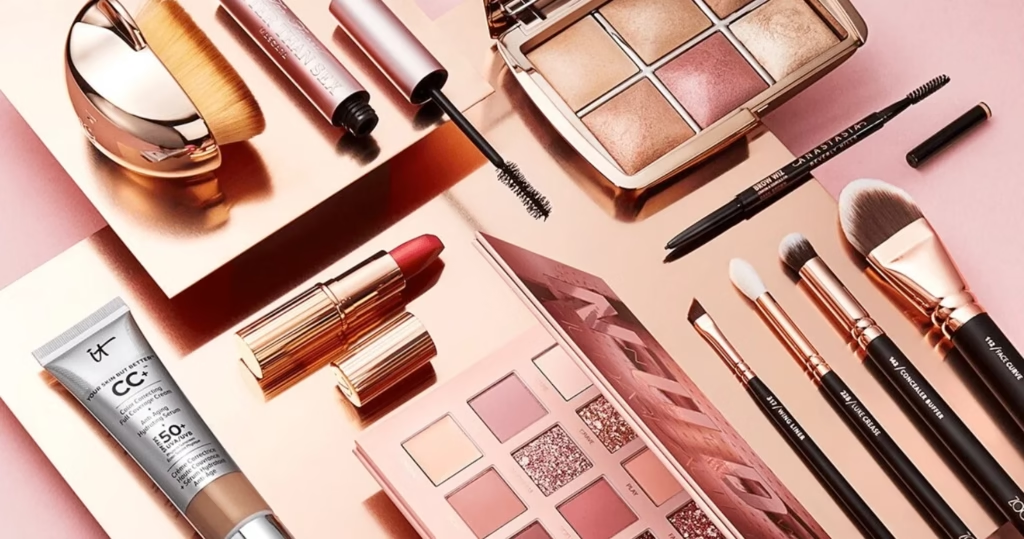
China’s beauty and personal care market is forecast to exceed $90 billion by 2028, making it the world’s second-largest beauty market after the United States and the fastest-growing among the top five. Consumer demand for international beauty brands — particularly from the US, France, South Korea, and Japan — is a defining characteristic of the Chinese beauty market, driven by a large and growing middle class with increasing disposable income and a strong preference for foreign brand cachet.
For international wholesale buyers and distributors looking to access China’s market, the opportunity is extraordinary. Brands including MAC, Estée Lauder, CeraVe, La Roche-Posay, Chanel, Tom Ford, and Kérastase all have established and growing consumer demand in China. The primary challenge for exporters is navigating China’s regulatory requirements, particularly the GACC registration framework, correctly and efficiently. This guide provides a comprehensive overview.
Understanding GACC Registration
What is GACC?
GACC stands for the General Administration of Customs of the People’s Republic of China. Since January 2022, all foreign manufacturers and exporters of food, cosmetics, and certain other goods destined for the Chinese market have been required to register with GACC before their products can be imported into China. This requirement applies to all cosmetics entering through both standard general trade channels and through China’s Cross-Border E-Commerce (CBEC) platforms.
What GACC Registration Means for Wholesale Exporters
For cosmetics wholesale exporters, GACC registration means that your supply chain partner, the overseas manufacturer, brand owner, or distributor, must be listed in the GACC database. When a shipment arrives at a Chinese port of entry, customs authorities verify that the exporter is registered. Unregistered exporters face shipment detention, return to origin, or destruction, all at the exporter’s cost.
Cosmetics Suppliers World is GACC registered, enabling us to supply MAC, CeraVe, La Roche-Posay, Estée Lauder, Tom Ford, Kérastase, and all of our brand portfolio to verified Chinese importers with GACC-compliant documentation as standard.
NMPA Requirements: Understanding Chinese Cosmetics Regulation
The National Medical Products Administration
The NMPA (National Medical Products Administration, formerly CFDA) is China’s cosmetics regulatory authority, responsible for approving and supervising cosmetics sold in the Chinese market. NMPA regulations distinguish between ordinary cosmetics (standard skincare, makeup, hair care) and special-use cosmetics (SPF products, hair colouring, hair perm, deodorant, skin whitening).
Ordinary vs Special-Use Cosmetics
Ordinary cosmetics, moisturisers, cleansers, makeup, standard hair care, can enter China through Cross-Border E-Commerce (CBEC) channels without full NMPA registration, provided they meet labelling and ingredient requirements. This makes CBEC an important entry route for brands that have not yet completed full NMPA registration for the Chinese market.
Special-use cosmetics, SPF (including Anthelios and CeraVe SPF products), hair colour, hair perm products, and skin whitening products require full NMPA registration before they can be sold in China through any channel. This registration process involves ingredient safety assessment, product formula filing, and clinical testing in some cases, typically taking 6-18 months for new products.
Cross-Border E-Commerce (CBEC): The Accelerated Entry Route
China’s CBEC framework allows overseas brands and retailers to sell to Chinese consumers through approved platforms (Tmall Global, JD Worldwide, Xiaohongshu/Little Red Book) without requiring full NMPA registration for ordinary cosmetics. CBEC has been one of the primary routes through which international beauty brands have accessed Chinese consumers before establishing formal market registration.
For wholesale buyers supplying Chinese CBEC operators, the key requirements are: product safety compliance with EU or US regulatory standards (accepted as equivalent in most CBEC contexts), GACC-registered exporter status, and Chinese-language product information documentation. Cosmetics Suppliers World provides all of these elements for Chinese CBEC buyers.
Top International Beauty Brands in Demand in China
Skincare
La Roche-Posay, CeraVe, and The Ordinary have experienced exceptional growth in China, driven by the KOL (Key Opinion Leader) ecosystem on platforms including Douyin (Chinese TikTok) and Xiaohongshu. Dermatologist-endorsed, ingredient-transparent brands resonate strongly with Chinese consumers who are increasingly sophisticated about skincare science. La Mer and Estée Lauder Re-Nutriv occupy the luxury skincare tier with strong gifting demand.
Makeup
MAC, Estée Lauder, Dior, Chanel, and NARS are the international makeup brands with the strongest established consumer demand in China. MAC, in particular, has a large and loyal Chinese consumer base with a strong gifting use case. Lancome, with its French heritage and luxury positioning, performs exceptionally well in China’s gifting-heavy retail culture.
Fragrance
The Chinese fragrance market is growing rapidly from a lower base than Western markets. Chanel No.5 and Dior J’adore have strong brand recognition through advertising investment. Tom Ford Private Blend and Maison Francis Kurkdjian are growing among younger premium consumers who follow global niche fragrance trends. The gifting use case is very strong in fragrance for Chinese New Year, Valentine’s Day, and birthdays.
Hair Care
Kérastase and Moroccanoil have strong demand in China from consumers who have experienced them through international salons and travel retail. L’Oréal Paris and Garnier serve the volume segment of the Chinese hair care market through established domestic distribution.
How Cosmetics Suppliers World Supports China’s Export
Cosmetics Suppliers World provides a complete China export service for wholesale beauty buyers:
- GACC registration: our exporter status is current and compliant — all shipments carry GACC-registered documentation
- NMPA compliance guidance: we advise on which products require full NMPA registration versus CBEC entry, and provide the required documentation for CBEC platform onboarding
- Chinese-language documentation: commercial invoices and product information in both English and simplified Chinese, where required
- ADR-compliant fragrance export: fragrance shipments to China comply with both ADR and Chinese DGR requirements
- Consolidated multi-brand shipments: multiple brands combined in a single GACC-compliant shipment to reduce logistics cost and complexity.
Frequently Asked Questions
Do I need GACC registration to export cosmetics to China?
Yes. Since January 2022, GACC registration has been mandatory for all foreign cosmetics exporters to China. Your supply chain partner (the exporter) must be GACC registered. Cosmetics Suppliers World is GACC registered and provides all required GACC documentation for shipments to China as standard.
How long does NMPA registration take for cosmetics?
Full NMPA registration for ordinary cosmetics takes approximately 3-6 months. Special-use cosmetics (SPF, hair colour, whitening) can take 12-18 months or longer, depending on formula complexity and testing requirements. The CBEC route provides a faster market entry option for ordinary cosmetics while the NMPA registration is in progress.
Which beauty brands are most in demand for Chinese wholesale import?
CeraVe, La Roche-Posay, The Ordinary (skincare); MAC, Estée Lauder, Dior, Lancome (makeup); Chanel, Tom Ford, MFK (fragrance); and Kérastase (hair care) represent the strongest wholesale demand from Chinese importers. Contact our team to discuss specific brand availability for China export.
